Trading in the Zone Summary: 7 Powerful Lessons That Make Every Trader Consistently Profitable
Ye “Trading in the Zone Summary” us har trader ke liye hai jiska analysis sahi hai, strategy sahi hai — phir bhi paisa doob raha hai.
Table of Contents

Socho Ek Trader Hai — Rahul
Pune ka ek 28 saal ka software engineer. Usne 6 mahine technical analysis seekhi — RSI, MACD, Bollinger Bands, sab kuch. Backtesting mein uski strategy 70% win rate de rahi thi.
Lekin jab real market mein utara?
Stop loss hit hota toh revenge trade karta. Profit aata toh darr ke jaldi exit karta. 3 mahine mein 40% capital gayi.
Kya Rahul ki strategy kharab thi? Nahi. Kya usse market ki samajh nahi thi? Nahi.
Problem thi uske dimag mein — uski trading psychology mein.
Yahi ek line mein hai is poori book ka core message. Aur is Trading in the Zone summary mein hum exactly yahi dekhenge — kaise Mark Douglas ne yeh problem identify ki, aur 7 actionable lessons mein solution diya.
Aur sirf theory nahi — har lesson ke baad Indian market ke liye practical application.
Trading in the Zone Summary: Core Message Ek Line Mein {#core-summary}
“Consistent trading success ka koi strategy se lena dena nahi. Sab kuch tumhare mindset se decide hota hai.” — Mark Douglas
Markets moment-to-moment random hain. Koi guarantee nahi ki next trade kya hogi. Toh agar market unpredictable hai, consistently profitable kaise bano?
Jawab: Tumhare reactions consistent hone chahiye. Tumhari thinking consistent honi chahiye. Tumhara execution consistent hona chahiye.
Yahi “trading in the zone” hai — ek aisi mental state jahan tum:
- Bina darr ke trade execute karte ho
- Loss ko personally nahi lete
- Market ko objective nazar se dekh paate ho
- Apne rules follow karte ho, bina hesitation ke
Mark Douglas Kaun The? {#mark-douglas}
Mark Douglas ne 1978 mein trading shuru ki. Shuru mein unhone bahut paisa gawaya. Lekin unhone quit nahi kiya — ulta apne aap se poochha:
“Meri strategy sahi hai, toh phir main consistently kyun fail ho raha hoon?”
Yahi sawaal unhe trading psychology ki taraf le gaya. Unhone 2 decades se zyada waqt traders ko coach kiya — beginners se lekar hedge fund managers tak. Woh Trading Behavior Dynamics ke founder bane aur trading psychology ke sabse bade pioneers mein se ek hain.
Unki 2 famous books:
| Book | Year | Focus |
|---|---|---|
| The Disciplined Trader | 1990 | Problem identify karna |
| Trading in the Zone | 2001 | Practical solution framework |
Mark Douglas ka 2015 mein nidhan hua. Lekin unka kaam aaj 2026 mein bhi trading community ki neenv hai — jab NSE pe retail participation record high pe hai aur crypto 24/7 chalta hai.
Lesson 1 – Trading in the Zone Summary: Market Tumhara Dushman Nahi, Tumhara Dimag Hai {#lesson-1}
Problem Kya Hai
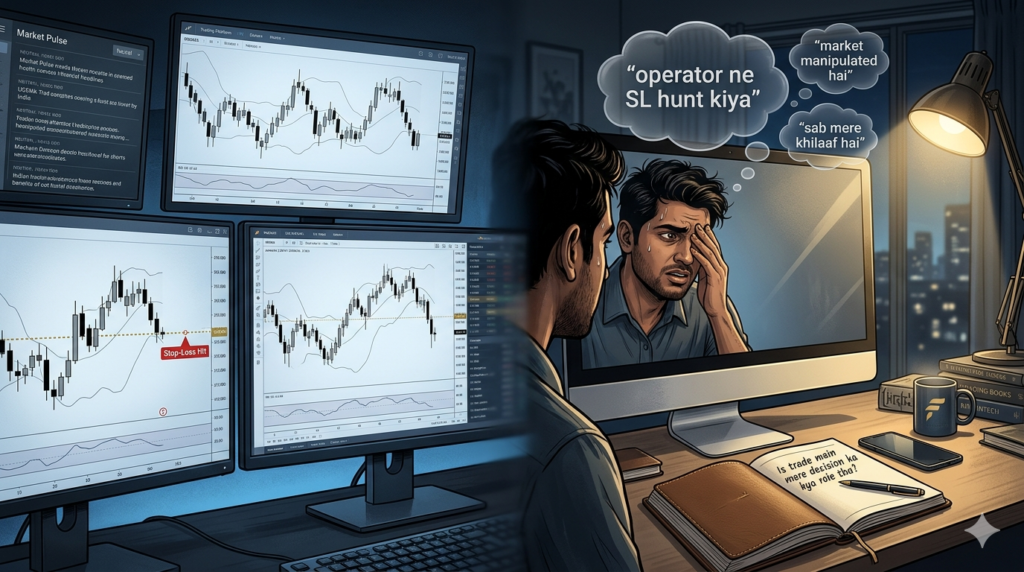
“Market ne mujhe maar diya.” “Operators ne mera stop loss hunt kiya.” “Market manipulated hai.”
Yeh sab sunne mein familiar lagte hain, right? Lekin yeh sab ek hi baat kehte hain: trader ne market ko personal dushman samjha.
Mark Douglas kehte hain: market neutral hai. Market kisi ko target nahi karta. Market sirf lakho traders ki collective action ka result hai — ek crowd ki psychology. Koi bhi single force permanently market ko control nahi kar sakti.
Jab tum loss lete ho, toh market ne tumhe hurt nahi kiya. Tumhare apne decision aur reaction ne hurt kiya.
Indian Market Angle: NSE Operator Theory
NSE aur BSE pe “operator theory” bahut popular hai. Log maan lete hain ki unka stop loss deliberately hunt kiya gaya. Kabhi kabhi institutional positioning se prices move karte hain — yeh sach hai. Lekin zyaadatar cases mein, stop loss isliye hit hua kyunki technically weak jagah tha.
Market ko blame karna ek comfortable story hai. Lekin yeh story improve nahi hone deti.
✅ Action Step
Aaj se trade journal shuru karo. Har trade ke baad ek line: “Is trade mein mere decision ka kya role tha?”
Slowly pattern dikhega — zyaadatar outcomes mein tumhara control tha, market ka nahi.
Lesson 2 – Trading in the Zone Summary: Consistency Strategy Se Nahi, State of Mind Se Aati Hai {#lesson-2}
Ek Shocking Observation
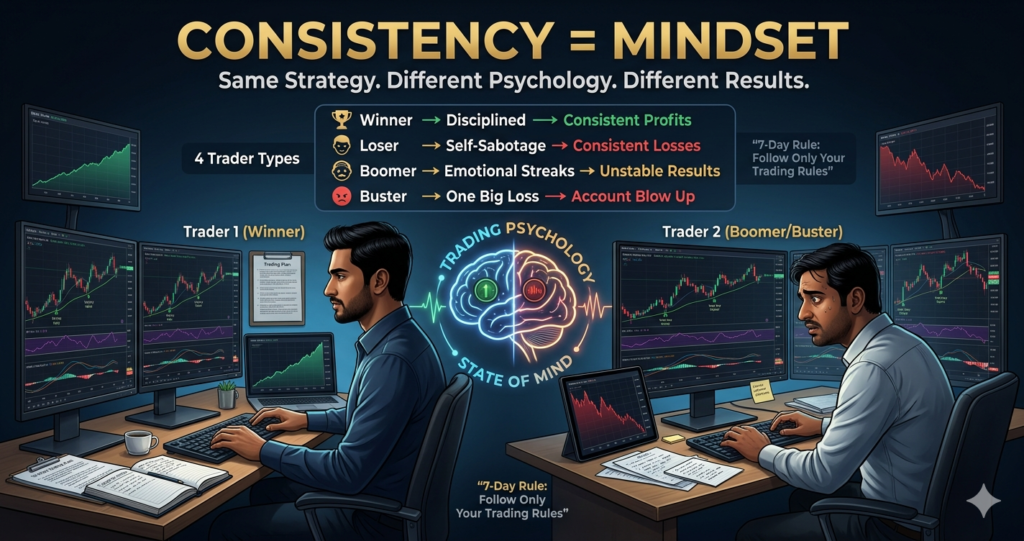
Do traders ek hi strategy use kar sakte hain. Ek profitable hoga, doosra nahi.
Kyun? Kyunki same signal pe:
- Ek trader fearlessly execute karega
- Doosra hesitate karega, over-size karega, ya premature exit karega
Consistency ek state of mind hai — ek aisi mindset jahan tum:
- Apne rules ko rules maante ho — randomly break nahi karte
- Market ke outcomes ko neutrally accept karte ho — na euphoria, na despair
- Ek trade ke result ko doosre trade pe influence nahi dene dete
The 4 Trader Types: Kahan Ho Tum?
Douglas traders ko 4 categories mein rakhte hain:
| Type | Behavior | Result |
|---|---|---|
| Winners | Rules follow, discipline high | Consistently profitable |
| Losers | Self-sabotage pattern | Consistently lose |
| Boomers | Emotionally driven, overconfident in streaks | Kabhi boom kabhi bust |
| Busters | One big loss se sab kho dete hain | Account blow up |
Zyaadatar retail traders Boomer ya Buster category mein hote hain. Goal hai Winner banana.
✅ Action Step
7-Day Rule: Agle 7 days mein sirf predefined rules ke according trade karo. Zero gut-feel trades. Log karo aur dekho consistency ka actual impact.
Lesson 3 – Trading in the Zone Summary: The 4 Deadly Fears Jo Har Trade Barbad Karte Hain {#lesson-3}
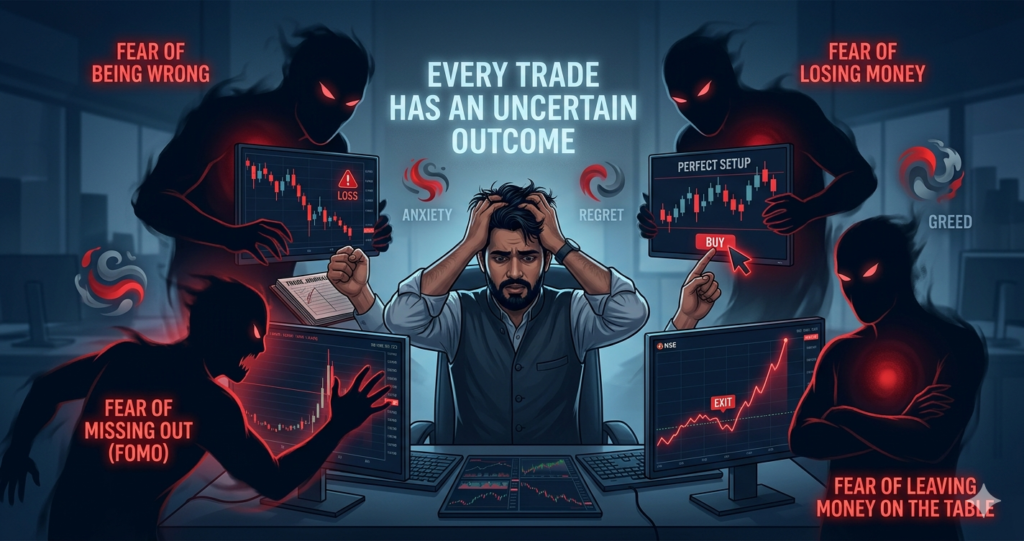
Yeh is Trading in the Zone summary ka sabse emotionally heavy section hai. Douglas identify karte hain 4 fears jo zyaadatar trading mistakes ke peeche hain.
Fear #1 – Fear of Being Wrong (Galat Hone Ka Darr)
Sabse common. Trade against jaata hai → trader loss accept karne ki bajaye hold karta rehta hai → hope karta hai market wapas aayega → chhoti loss badi ban jaati hai.
Ek NSE F&O trader ki classic galti: Nifty put buy kiya ₹80 mein. Market upar gaya, put ₹30 pe aa gayi. Trader socha “ab kya loss loon” — hold kiya → ₹5 pe expire hui.
Fear #2 – Fear of Losing Money (Paisa Kho Jaane Ka Darr)
Signal perfect hai, lekin trader trigger nahi dabaata. Ya dabaata hai toh position size itna chhota hota hai ki meaningful profit impossible hai.
Fear #3 – Fear of Missing Out (FOMO)
Market tezi se move karta hai. Trader entry miss karta hai. Phir bhi overpriced entry pe jump karta hai — “nahi toh aur upar jaayega.” Usually yahi tops pe buying hoti hai.
Fear #4 – Fear of Leaving Money on the Table
Trade profit mein chal raha hai. Trader target se pehle exit kar leta hai — “kya pata wapas aa jaaye.” Phir market aage jaata hai. Deep regret.
Root Cause: Certainty Ki Galat Expectation
Yeh charo fears ek jagah se aate hain: outcomes mein certainty ki expectation.
Hamara dimag certainty dhundta hai. Lekin market probabilistic hai. Jab hum certain environment mein certainty expect karte hain uncertain situations mein, toh emotional system malfunction karta hai.
Solution: Accept karo ki har trade ek probability game hai. Individual trade result nahi, pattern of results matter karta hai.
Indian Bonus — Fear #5: SEBI/News Fear
Yeh Douglas ne cover nahi ki lekin Indian traders ke liye real hai. Budget day, RBI policy, SEBI circular — traders in events ke around worst timing pe emotional trades karte hain.
✅ Action Step
Fear Audit: Apni last 10 trades dekho. Har mistake mein in 4 fears mein se kaun dominant tha? Pattern dikhega. Usi ek fear pe pehle kaam karo.
Lesson 4 – Trading in the Zone Summary: Probability Mein Socho — Trader Ka Asli Edge {#lesson-4}

Yeh is poori Trading in the Zone summary ka most important concept hai.
Casino Analogy Jo Sab Kuch Change Kar Deti Hai
Ek casino socho. Blackjack mein house ka edge sirf 1-2% hota hai. Matlab ek individual hand mein casino lose bhi kar sakta hai. Lekin 1,000 hands ke baad casino definitely profitable hoga — kyunki statistics unke favor mein hain.
Successful trader usi casino ki tarah sochta hai.
❌ Wrong thinking: “Yeh trade profitable hogi?”
✅ Right thinking: “Meri strategy ka edge kya hai, aur agar main agle 100 trades consistently execute karoon toh kya result hoga?”
Individual trade outcome irrelevant ho jaata hai. Process relevant hota hai.
Why This Changes Everything
Probability thinking se:
- Ek loss devastate nahi karta — yeh expected distribution ka normal part hai
- Ek win overconfident nahi karta — luck aur skill mein difference pata rehta hai
- Rules religiously follow hote hain — kyunki long-term value clearly dikhti hai
The 5 Fundamental Truths of Trading (Mark Douglas)
Douglas in 5 truths ko deeply internalize karne ko kehte hain:
- Kuch bhi ho sakta hai — certainty impossible hai
- Tum bina sab jaane bhi paise kama sakte ho — edge enough hai
- Random distribution of wins and losses — even best strategy mein losing streaks hain
- An edge = higher probability, not guarantee — 100% never hoga
- Every market moment is unique — past trades current pe apply nahi hoti
Crypto aur 2026 Markets Mein Application
Bitcoin, Ethereum, altcoins — 24/7 volatile markets mein probability thinking aur bhi critical hai. 2024-25 bull run mein jo traders “yeh toh rocket karega” emotion se ghuse, woh tops pe fanse. Jo 60% win rate strategy ke saath systematic the, unhone consistently profit kiya.
✅ Action Step
Monte Carlo Exercise: Apni strategy ka historical win rate nikalo. Maan lo 60% hai. Phir mentally simulate karo: even 60% win rate mein 5-6 consecutive losses statistically normal hain. Yeh exercise fear dramatically reduce karta hai.
Lesson 5 – Trading in the Zone Summary: Market Ko Uski Apni Nazar Se Dekho {#lesson-5}
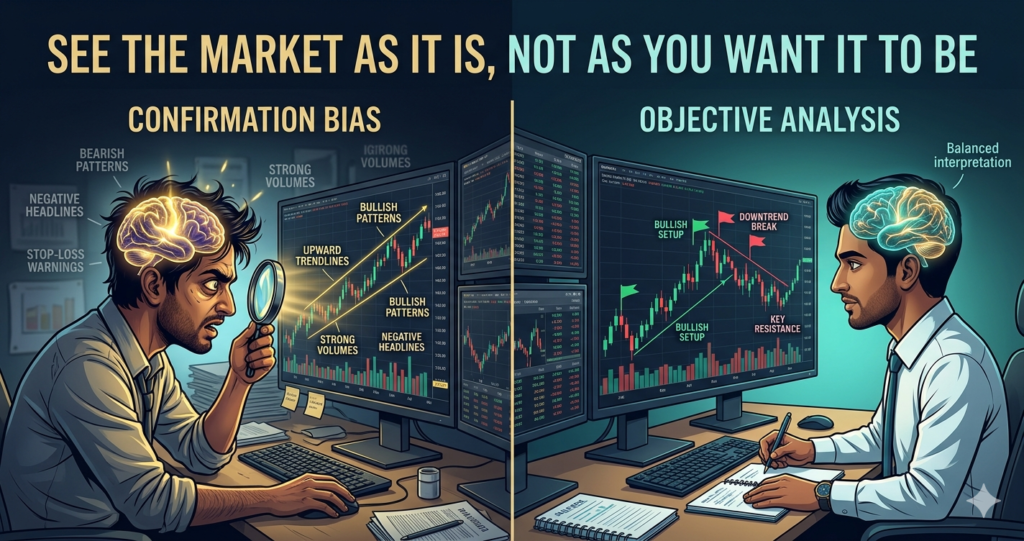
Confirmation Bias — Hidden Enemy
Jab hum trade enter karte hain, humara dimag automatically trade ko favor karne wali information zyaada notice karta hai aur contradicting signals ignore karta hai. Ise confirmation bias kehte hain.
Douglas kehte hain: market apni language bolti hai. Tumhara kaam hai woh language suno — apni imposed nahi karo.
3 Market Truths Jo Accept Karni Hain
- Kuch bhi ho sakta hai — past pattern future guarantee nahi karta
- Tum bina certainty ke bhi profitable ho sakte ho — edge enough hai
- Har moment market mein unique hai — kal wali trade aaj apply nahi hoti
The Mental Framework Problem
Douglas kehte hain: hamare paas ek “mental framework” hota hai — beliefs ka set jo hum market pe impose karte hain.
Example: Agar aapne 3 baar Reliance Industries pe profit kiya, toh woh automatically “safe stock” lagtay hai. Yeh sach nahi — woh 3 trades coincidental thi. Lekin mental framework us stock ko differently treat karta hai, aur future decisions affect hote hain.
Solution: Har trade ko fresh eyes se dekho. Past trades ki attachment hato.
✅ Action Step: Pre-Trade 3-Question Check
Har trade se pehle yeh 3 sawaal:
- “Kya yeh trade sirf isliye le raha hoon kyunki is direction mein jaana achha lag raha hai?”
- “Agar chart ulta hota, toh kya main opposite direction mein equally comfortable hota?”
- “Kya mera stop loss market structure pe based hai ya meri pain tolerance pe?”
Lesson 6 – Trading in the Zone Summary: Risk Ko Sirf Manage Nahi, Truly Accept Karo {#lesson-6}
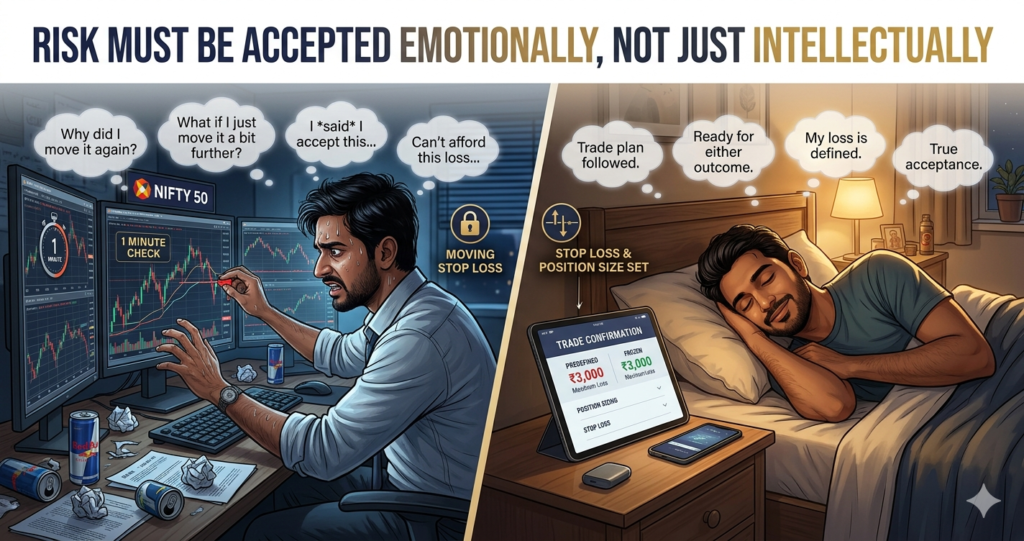
Tactical Risk Management vs Psychological Risk Acceptance
“Risk management” ke baare mein sab jaante hain — stop loss, position sizing, 1-2% risk per trade. Yeh tactical hai. Douglas ek deeper level ki baat karte hain.
Tactical risk management aur psychological risk acceptance — yeh alag cheez hain.
Ek trader ka stop loss ₹2,000 pe hai. Intellectually woh jaanta hai ₹2,000 lose kar sakta hai. Lekin jab trade us direction mein jaata hai:
- Stop loss move karta hai
- Size reduce karta hai panic mein
- Ya phir ₹2,000 loss pe devastated ho jaata hai
Matlab uski actual psychological acceptance kabhi thi hi nahi — sirf intellectual acceptance thi.
Douglas kehte hain: “You must accept the risk at a core emotional level, not just intellectually.”
The “Uncomfortable Amount” Test
Ek simple test:
“Kya aap apni current position ke saath raat ko chain se so sakte ho? Bina alarm ke, bina baar baar phone check kiye?”
Agar nahi — position size zyaada hai. Risk truly accepted nahi hua.
Real rule: Trade size woh hona chahiye jo tumhare saath kaam kare, tumhare khilaaf nahi.
Indian F&O Data: Why This Matters
SEBI ke data ke hisab se 90%+ retail F&O traders lose karte hain. Ek badi reason: leverage misuse. Nifty weekly options mein log aise size le lete hain jo unki capital ke relative bahut bada hota hai. Risk intellectually samajh mein aata hai, emotionally accept nahi hota. Result: panic exit, stop loss removal, account blow up.
✅ Action Step
Apni agle trade mein yeh karo: Position size tab decide karo jab maximum loss amount dekho — rupees mein, percentage mein nahi. “₹3,000 max loss” vs “2% risk” — ek concrete, doosra abstract. Concrete figure se real acceptance zyaada hoti hai.
Lesson 7 – Trading in the Zone Summary: “The Zone” — Consistency Ki Highest State {#lesson-7}
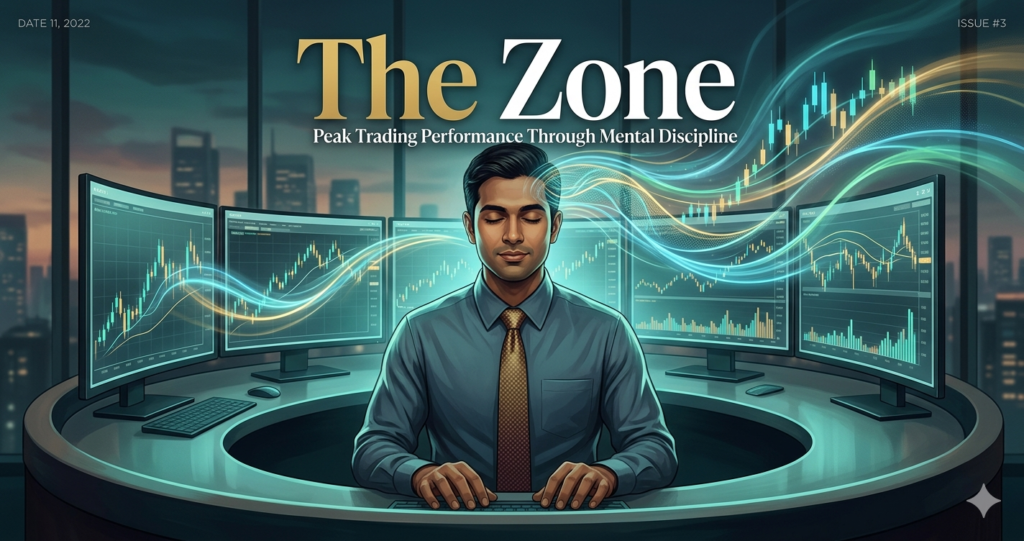
Kya Hota Hai “Zone” Mein?
Athletes ise “flow state” kehte hain. Traders ke liye “zone” ka matlab hai:
- Bina hesitation ke execution — signal aata hai, tum immediately confidently act karte ho
- Outcomes se complete detachment — win ya loss, dono pe equally neutral reaction
- Pure market focus — koi distractions nahi, sirf price action
- Rules automatically follow hote hain — struggle nahi, compliance natural hai
Zone Mein Jaane Ki 3 Conditions
1. Winning Attitude Yeh positivity nahi hai. Yeh ek deep belief hai: “Main apni strategy pe kaam karta rahoonga, long-term results aayenge.” Individual outcomes matter nahi karte.
2. Emotional Neutrality Na fear, na greed, na excitement. Market ke har move ko ek possibility ki tarah dekho — threat ya opportunity ki tarah nahi.
3. Present-Moment Focus Past trades ka baggage nahi. Future trades ki anxiety nahi. Sirf is moment ki market.
“Now Moment Opportunity Flow”
Douglas ek beautiful phrase use karte hain: “now moment opportunity flow.”
Market hamesha kuch na kuch signal de raha hai. Trader ka kaam hai present mein rehna aur us signal ko unfiltered, unbiased dekna — na past loss ka anger le ke, na upcoming profit ki excitement le ke.
Yeh meditation ke concepts se milta julta hai. Kai professional traders — including many at top hedge funds — active meditation practice karte hain exactly isi reason se.
Zone Create Karne Ka System
Zone force nahi kar sakte. Lekin optimal conditions create kar sakte ho:
Pre-Trading Ritual (5 minute):
- Market kholne se pehle 3 deep breaths
- Apni rules read karo
- Define karo: “Aaj maximum ___ trades. Maximum ___ total risk.”
Post-Loss Protocol:
- Ek loss ke baad immediately next trade mat lo
- 15-30 minute break mandatory
Daily Trade Limit:
- 3-4 quality trades >> 15 mediocre trades
- Emotional capacity finite hai — daily “quota” protect karo
End-of-Day Review:
- Emotions ke saath nahi, data ke saath review karo
- “Strategy ki galti ya execution ki galti?” — yeh ek sawaal kaafi hai
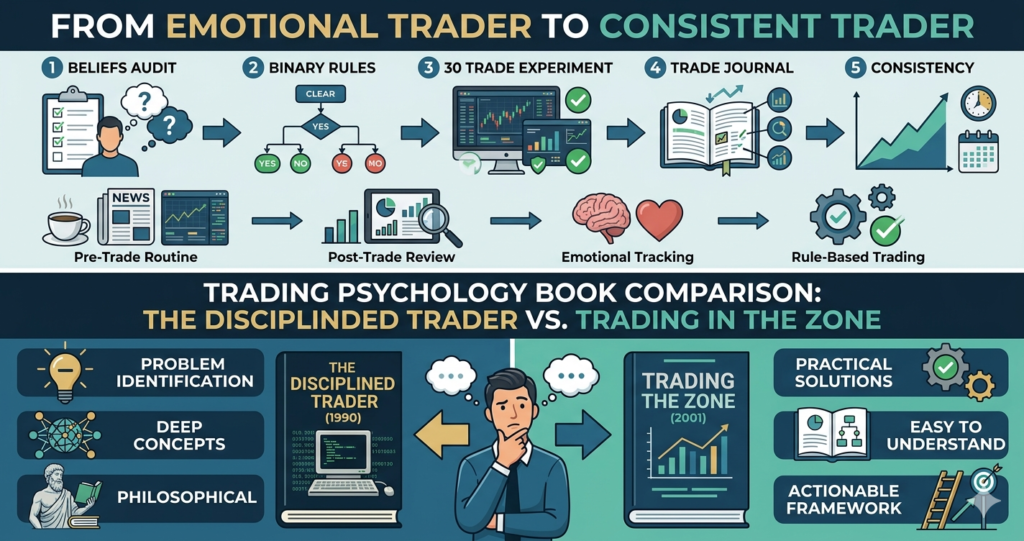
Daily Action Plan: Ye Lessons Apply Kaise Karein {#action-plan}
Theory samajh mein aayi. Ab ek systematic framework:
Week 1: Beliefs Audit
Apne aap se honest sawaal poochho:
- “Kya main sach mein accept karta hoon ki meri next trade lose ho sakti hai?”
- “Kya ek loss ke baad mera next trade ka size ya style change hota hai?”
- “Kya main market ko blame karta hoon jab kuch galat hota hai?”
Answers likho. Yeh tumhara starting point hai.
Week 1-2: Binary Rules Banao
Vague rules kaam nahi karti. “Achhi entry wait karo” — yeh rule nahi hai.
Concrete binary rule example:
“RSI 30 se upar aaye + 20 EMA ke upar price ho + last swing high break kare → Buy. Stop loss swing low ke 1% niche. Target 2:1 risk-reward.”
Jab rules binary (yes/no) hote hain, tabhi consistent execution possible hai.
Ongoing: Sample Size Mindset
Agle 30 trades ek experiment samjho. Individual trade success/failure nahi hai. 30 trades ka aggregate success/failure hai.
Tracking sheet format:
| Trade # | Entry | Exit | Rule Followed? | Emotion at Entry | Emotion at Exit | P&L |
|---|---|---|---|---|---|---|
| 1 | … | … | Yes/No | … | … | … |
Daily: Pre + Post Trade Ritual
Pre-trade (5 min): Chart se pehle breathe → rules read karo → limits define karo.
Post-trade (2 min): Was this in my plan? Did I follow rules? One lesson if any.
Judge process, not result. Yeh most important shift hai.
Trading in the Zone vs The Disciplined Trader {#comparison}
Aksar yeh sawaal aata hai:
| Aspect | The Disciplined Trader (1990) | Trading in the Zone (2001) |
|---|---|---|
| Focus | Problem identify karna | Solution framework dena |
| Tone | Philosophical, dense | Practical, accessible |
| Difficulty | Heavy read | Much easier |
| Best For | Deep conceptual dive | First book — start here |
| Recommendation | Padhna zaroori nahi | Zaroor padho |
Final recommendation: Trading in the Zone pehle padho. Agar deep dive karni ho toh The Disciplined Trader baad mein.
Amazon link: Trading in the Zone — Mark Douglas
Top 10 Quotes Aur Unka Practical Matlab {#quotes}
1. “Consistency is a state of mind.” → Consistent results chahiye toh pehle consistent thinking develop karo. Strategy secondary hai.
2. “The best traders have developed an attitude that gives them the mental flexibility to flow in and out of trades based on what the market is telling them.” → Rigid nahi raho. Market ke saath flow karo. Apni story impose mat karo.
3. “You will know you have truly accepted the risk when you no longer have the potential to feel betrayed by the market.” → Jab loss pe “market ne dhoka diya” nahi kahtey, tabhi real risk acceptance aaya hai.
4. “The hard, cold reality of trading is that every trade has an uncertain outcome.” → Certainty dhundhna stop karo. Probability ke saath kaam karo.
5. “The markets are not really about the money; they are about developing the proper mental framework.” → Paisa outcome hai. Mindset primary hai.
6. “If you can learn to create a state of mind that is not affected by the market’s behavior, the struggle will cease to exist.” → Goal hai market se emotionally independent hona — indifferent nahi, neutral.
7. “Most traders don’t know what they believe about trading.” → Apni beliefs examine karo. Beliefs se actions aate hain, actions se results.
8. “Think of it this way: if you were afraid of the market, how could you consistently take advantage of its opportunities?” → Fear aur consistent profits simultaneously nahi ho sakti.
9. “At the core of successful trading is a belief in an uncertain outcome with an edge in your favor.” → Uncertain outcome accept karo + apne edge pe trust karo. Yeh balance hai.
10. “Every trade is just one of many trades you’re going to make.” → Ek trade pe emotionally over-invest mat karo. Pattern of trades result hai, single trade nahi.
Book Ki Limitations: Fair Picture {#limitations}
Trading in the Zone summary honest hogi tabhi jab limitations bhi batayein:
1. Koi specific trading strategy nahi deta Douglas psychology ke baare mein hai, setups ke baare mein nahi. “Kaunsa stock kharidoon” — yeh yahan nahi milega.
2. Thodi repetitive hai Same concepts different angles se repeat hote hain. Reinforcement hai ya boring — reader pe depend karta hai.
3. Western markets focus Douglas US futures markets se the. Core psychology universal hai, lekin examples India-specific nahi hain. Aapko apply karte waqt Indian context add karna hoga.
4. 2001 ki book — Crypto aur Algo Trading Cover Nahi Modern markets — crypto, HFT, algo bots — 2001 ke baad evolve hue. Core psychology same hai, but specific execution context alag hai.
Conclusion: Trading in the Zone Ka Real Message
Mark Douglas ne ek simple lekin profound truth share ki: markets ki problem nahi hai. Problem hum hain.
Hum aise dimag ke saath born hue hain jo certainty chahta hai, loss se bachna chahta hai, uncertain environments mein bhi patterns dhundhta hai. Yeh sabhi tendencies trading mein fail karvati hain.
Is Trading in the Zone summary ke 7 core lessons ek baar aur:
- Market neutral hai — blame mat karo, accountability lo
- Consistency state of mind hai — strategy nahi
- 4 fears identify aur dissolve karo — being wrong, losing, FOMO, leaving money
- Probability mein socho — individual outcomes irrelevant hain
- Market ko objectively dekho — confirmation bias hato
- Risk truly accept karo — emotionally, not just intellectually
- Zone cultivate karo — pre-trade rituals, rules, emotional neutrality se
Yeh concepts ek baar padhne se nahi aate. Inhe practice karna padta hai, fail karna padta hai, wapas try karna padta hai.
Lekin jo traders yeh kaam karte hain — woh Rahul wali situation se permanently bahar aa jaate hain. Unki strategy same rehti hai. Lekin unka execution transform ho jaata hai.
Trading in the Zone sirf ek book nahi hai. Yeh ek mirror hai — jisme tum apni sabse badi trading problem dekh sakte ho: khud ko.
FAQs: Trading in the Zone Summary {#faqs}
Q1. Trading in the Zone summary mein sabse important lesson kaunsa hai?
Lesson 4 — Probability Mein Socho. Yeh ek concept hi zyaadatar emotional trading mistakes solve kar deta hai. Jab tum individual trade outcome ko irrelevant maan lete ho aur 100-trade pattern pe focus karte ho, fear aur greed dono reduce ho jaate hain.
Q2. Kya Trading in the Zone Indian stock market ke liye relevant hai?
Bilkul Psychology universal hai. NSE, BSE, ya F&O — sabmein same emotional traps hain jo Douglas describe karte hain. Fear, greed, FOMO — yeh Mumbai mein utna hi kaam karte hain jitna New York mein. Isliye is summary mein Indian examples specifically diye hain.
Q3. Trading in the Zone book kab padhni chahiye?
Jab aap basic technical analysis samajh chuke ho aur consistently trade kar rahe ho lekin results inconsistent hain. Bilkul beginners ke liye pehle technical foundation build karna better hai — phir yeh book.
Q4. Kya trading psychology books se actually improvement hoti hai?
Books alone se nahi — implementation se. Agar sirf padhte ho aur apply nahi karte, koi fark nahi padega. Lekin agar concepts actively practice karte ho — journaling, binary rules, pre-trade rituals — significant improvement possible hai. Kai successful NSE traders is book ko turning point maante hain.
Q5. Trading mein emotions completely eliminate kar sakte hain?
Nahi — aur yahi goal bhi nahi hona chahiye. Goal hai emotions ko notice karna aur unhe decisions ko override nahi karne dena. Emotions always rahenge — aap choose kar sakte ho ki unke basis pe act karna hai ya nahi.
Q6. Mark Douglas ki “trading in the zone” concept really work karti hai?
Haan, lakho traders globally is framework ko effective maante hain. Lekin yeh ek overnight fix nahi hai — ek mindset shift hai jo months of deliberate practice maangti hai. Is Trading in the Zone summary ke action steps regularly follow karo.
Q7. Probability mein sochna practically kaise shuru karein?
Simple: apni strategy ka historical win rate calculate karo. Maan lo 55% hai. Phir har trade se pehle remind karo: “Is trade mein 55% chance profit ka hai, 45% loss ka. Dono equally okay hain. Main long-term edge ke liye kaam kar raha hoon.”
Related Reading
Agar yeh Trading in the Zone summary tumhare kaam aayi, toh yeh bhi zaroor padho:
- The Disciplined Trader — Mark Douglas ki pehli book (deeper conceptual dive)
- Market Wizards — Jack Schwager (top traders ke interviews — psychology wale chapters goldmine hain)
- Thinking, Fast and Slow — Daniel Kahneman (behavioral economics, trading psychology ko scientifically validate karta hai)
- The Psychology of Money — Morgan Housel (money behavior, investing mindset)
Is Trading in the Zone summary ko un traders ke saath share karo jinki strategy sahi hai lekin results nahi aa rahe. Shayad unhe bhi yahi mirror chahiye.