
SIP vs Lumpsum — agar aap 2026 me mutual funds me investment start karne ka plan bana rahe ho, to probably ye aapke mind ka sabse bada question hoga.
“Har month SIP karu ya mere paas jo paisa available hai use ek saath lumpsum invest kar du?”
Simple answer: SIP aur lumpsum me koi universal winner nahi hai.
Agar aap salaried ho, regular monthly income aati hai aur gradually wealth build karna chahte ho, to SIP convenient ho sakti hai. Lekin agar aapke paas already invest karne ke liye large amount available hai aur aap long-term market volatility handle kar sakte ho, to lumpsum investment bhi suitable ho sakta hai.
Is complete SIP vs Lumpsum guide me hum difference, returns, risk, market timing, real-life examples aur different investor situations ko simple Hinglish me samjhenge.Quick Answer: Regular income aur gradual investing ke liye SIP convenient ho sakti hai. Already available investible corpus ke liye lumpsum consider kiya ja sakta hai. Final choice aapke goals, time horizon, cash availability aur risk tolerance par depend karti hai.
Quick Answer: Regular income aur gradual investing ke liye SIP convenient ho sakti hai. Already available investible corpus ke liye lumpsum consider kiya ja sakta hai. Final choice aapke goals, time horizon, cash availability aur risk tolerance par depend karti hai.
Table of Contents
SIP vs Lumpsum: Quick Comparison
Sabse pehle SIP vs Lumpsum investment ko simple table me samajhte hain
SIP vs Lumpsum: Which One Should You Choose?
A quick side-by-side comparison to help you decide your investment strategy
| Factor | SIP | Lumpsum |
|---|---|---|
| Investment Style | Regular instalments | One-time investment |
| Cash Requirement | Gradually required | Large amount upfront |
| Market Timing Pressure | Relatively lower | Higher |
| Rupee Cost Averaging | Naturally available | Normally not available |
| Discipline | Automated investing possible | Investor-driven |
| Market Volatility | Investment spread over time | Entire amount exposed |
| Best Suited For | Regular income investors | Investors with available corpus |
| Long-Term Potential | Market dependent | Market dependent |
| Guaranteed Returns? | No | No |
Important: Mutual fund returns guaranteed nahi hote. SIP sirf investment ka method hai; wo market risk ko eliminate nahi karta.
What is SIP? SIP Kya hota hai?
SIP (Systematic Investment Plan) mutual fund me invest karne ka ek method hai jisme aap fixed amount ko regular intervals par invest karte ho.
For example:
- ₹2,000 every month
- ₹5,000 every month
- ₹10,000 every month
Agar aap ₹5,000 monthly SIP karte ho, to market high ho ya low, investment scheduled basis par continue reh sakti hai.
SIP Kaise Kaam Karti Hai?
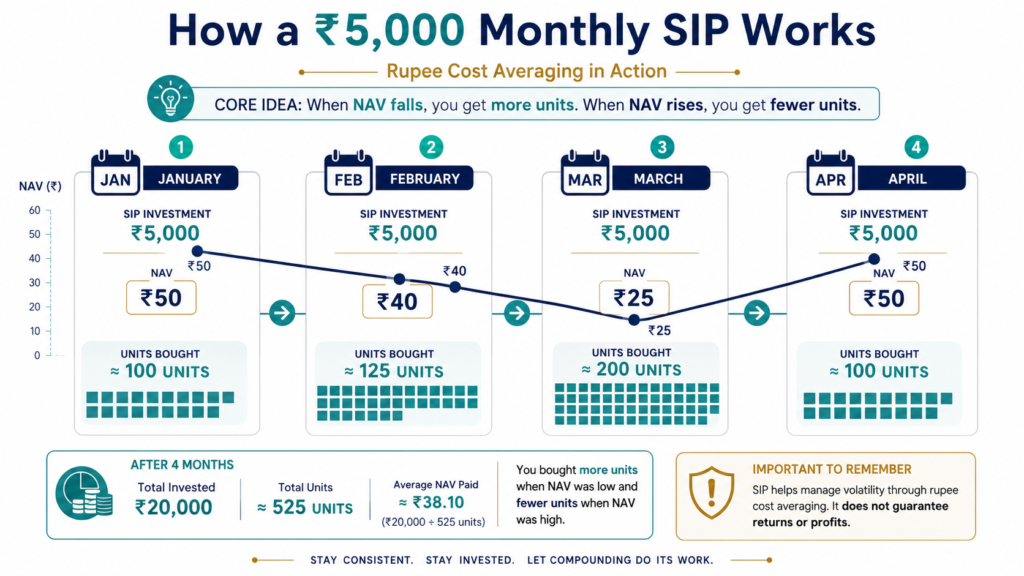
Mutual funds ke units NAV (Net Asset Value) ke basis par allot hote hain.
Simple hypothetical example:
| Month | SIP Amount | NAV | Approx. Units |
| January | ₹5,000 | ₹50 | 100 |
| February | ₹5,000 | ₹40 | 125 |
| March | ₹5,000 | ₹25 | 200 |
| April | ₹5,000 | ₹50 | 100 |
NAV lower hone par same investment amount se more units mil sakte hain, aur NAV higher hone par fewer units.
Isi concept ko commonly rupee cost averaging kaha jata hai.
SIP Ke Major Benefits
1. Investment Discipline
Salary aane ke baad automatically fixed amount invest karna long-term investing habit build karne me help kar sakta hai.
2. Small Amount Se Start
Large capital ka wait karna zaroori nahi. Different schemes ke minimum investment requirements alag ho sakte hain.
3. Market Timing Pressure Kam
Har month “market abhi expensive hai ya cheap?” decide karne ki zaroorat comparatively kam ho jati hai.
4. Rupee Cost Averaging
Market fluctuations ke dauran different NAV levels par units purchase hoti rehti hain.
But remember: rupee cost averaging profit ki guarantee nahi hai.
What is Lumpsum Investment?
Lumpsum investment ka simple meaning hai ek relatively large amount ko one time invest karna.
For example, aapko:
- ₹1 lakh bonus mila,
- ₹5 lakh savings available hai,
- property sale se investible money mila,
- ya FD mature hui,
aur aap ₹5 lakh ek hi time mutual fund me invest kar dete ho.
Ye lumpsum investment hai.
Lumpsum Ka Potential Advantage
Agar ₹5 lakh already available hai aur aap use invest kar dete ho, to entire ₹5 lakh Day 1 se market me participate karta hai.
Long-term rising market me ye important advantage ho sakta hai.
Lekin iska opposite bhi possible hai.
Agar investment ke immediately baad market sharply fall kare, to entire corpus us decline se exposed rahega.
Isi wajah se SIP vs Lumpsum ka answer investor ki situation par depend karta hai.
SIP vs Lumpsum: 7 Major Differences
1. Investment Frequency
SIP:
₹5,000 → ₹5,000 → ₹5,000 → every month
Lumpsum:
₹5,00,000 → one-time investment
SIP future income ko gradually invest karne ke liye natural structure provide karti hai.
Lumpsum tab relevant hota hai jab capital already available ho.
2. Market Timing Risk
Suppose aapne ₹5 lakh lumpsum invest kiya aur next month market significantly fall kar gaya.
Aapka entire ₹5 lakh market decline ke exposure me tha.
SIP me capital gradually enter hota hai, isliye initial investment timing ka impact spread ho sakta hai.
Lekin iska matlab ye nahi ki SIP always superior hai.
Agar market continuously rise kare, to waiting capital gradually deploy karne se investor possible growth miss bhi kar sakta hai.
3. Rupee Cost Averaging
SIP vs Lumpsum ka popular difference rupee cost averaging hai.
SIP me fixed amount different NAV levels par invest hota hai.
Market fall:
same ₹5,000 → more units
Market rise:
same ₹5,000 → fewer units
Lumpsum me generally initial investment ek particular NAV level par hota hai.
4. Cash Flow Requirement
Ye difference beginners often ignore kar dete hain.
Suppose Rahul earns ₹50,000 monthly aur comfortably ₹5,000 save kar sakta hai.
Uske paas ₹6 lakh immediately available nahi hai.
Uske liye:
₹5,000 monthly SIP
naturally fit ho sakti hai.
Ab Priya ke paas ₹6 lakh already savings me available hai.
Uska question different hai:
“₹6 lakh abhi invest karu ya next 12 months me gradually?”
Isliye SIP aur lumpsum comparison sirf returns ke basis par nahi karna chahiye.
5. Investment Discipline
SIP automation disciplined investing me help kar sakti hai.
Lumpsum investors ko future investments ke liye consciously additional capital deploy karna pad sakta hai.
Isliye beginners aur salaried investors ko SIP psychologically easier lag sakti hai.
6. Volatility Experience
Lumpsum me complete investment market movements experience karta hai.
SIP me upcoming instalments abhi invest nahi hui hoti.
Market crash psychologically uncomfortable ho sakta hai, especially jab large lumpsum recently invest kiya ho.
Lekin investment risk fund ke underlying assets par bhi depend karta hai—not simply SIP versus lumpsum.
7. Compounding Opportunity
Yahan ek important misconception hai.
“SIP me compounding zyada hoti hai?”
Not necessarily.
Suppose Investor A ke paas today ₹6 lakh available hai.
Investor B next 10 years me ₹5,000 monthly earn/save karke invest karega.
Dono ka total contribution eventually ₹6 lakh ho sakta hai, but comparison equal nahi hai.
Investor A ka ₹6 lakh Day 1 se invested ho sakta hai.
Investor B ka paisa gradually available hota hai.
Therefore capital availability ko ignore karke SIP aur lumpsum returns compare karna misleading ho sakta hai.
SIP vs Lumpsum Returns: Which Gives Better Returns?
Ye probably article ka most important question hai:
SIP vs Lumpsum Which Gives Better Returns?
Answer:
Market path par depend karta hai.
Koi investment method har market condition me guaranteed winner nahi hai.

Scenario 1: Market Continuously Rising Hai
Imagine market next several years steadily rise karta hai.
Agar entire capital Day 1 se available tha, lumpsum investment ko advantage mil sakta hai because more money earlier invested tha.
Scenario 2: Investment Ke Baad Market Crash
Suppose aap invest karte ho aur uske baad market sharply fall karta hai.
Lumpsum portfolio ka entire invested capital decline experience karega.
SIP investor meanwhile future instalments lower NAV par invest kar sakta hai.
Scenario 3: Volatile Market
Market:
Up → Down → Up → Down → Recovery
SIP different price levels par investments spread kar sakti hai.
Lekin final returns underlying mutual fund performance aur market movement par depend karenge.
SIP vs Lumpsum During Market Crash
Market crash ke time sabse common question hota hai:
“SIP band kar du?”
Sirf market fall hone ki wajah se long-term investment strategy abruptly change karna automatically right decision nahi hai.
Agar financial goal, investment horizon aur risk profile unchanged hai, falling NAV future SIP instalments ko more units purchase karne ka opportunity de sakti hai.
Lekin emergency fund ya near-term required money ko high-risk investments me daalna alag issue hai.
Lumpsum During Market Crash?
“Market 10% gir gaya, ab bottom aa gaya” assume karna dangerous ho sakta hai.
Market:
10% fall → another 10% fall → further decline
bhi kar sakta hai.
Perfect bottom consistently identify karna extremely difficult hai.
Mere Paas ₹5 Lakh Hai: SIP or Lumpsum?
Ab practical example.

Suppose aapke paas ₹5,00,000 available hai.
Option 1: Full Lumpsum
Entire ₹5 lakh immediately invest.
Potential advantage: Full amount earlier market participation karta hai.
Risk: Short-term decline hua to entire corpus affected.
Option 2: Gradual Investment
₹5 lakh ko several instalments me deploy karna.
Isse entry timing spread hoti hai, but remaining money meanwhile market me fully invested nahi hota.
Option 3: SIP + Lumpsum
Aap existing monthly SIP continue karte ho aur additional surplus capital ko separately invest karte ho.
SIP aur lumpsum mutually exclusive nahi hain.
Option 4: STP
Eligible mutual-fund setup me investor ek scheme me amount park karke predetermined intervals par another scheme me transfer karne ke liye Systematic Transfer Plan (STP) use kar sakta hai.
STP ko “guaranteed better strategy” nahi samajhna chahiye; suitability, taxation, exit load and scheme-specific rules consider karne chahiye.
SIP vs Lumpsum for Beginners: Which is Better?
Beginners ke liye decision ko unnecessarily complicated nahi banana chahiye.
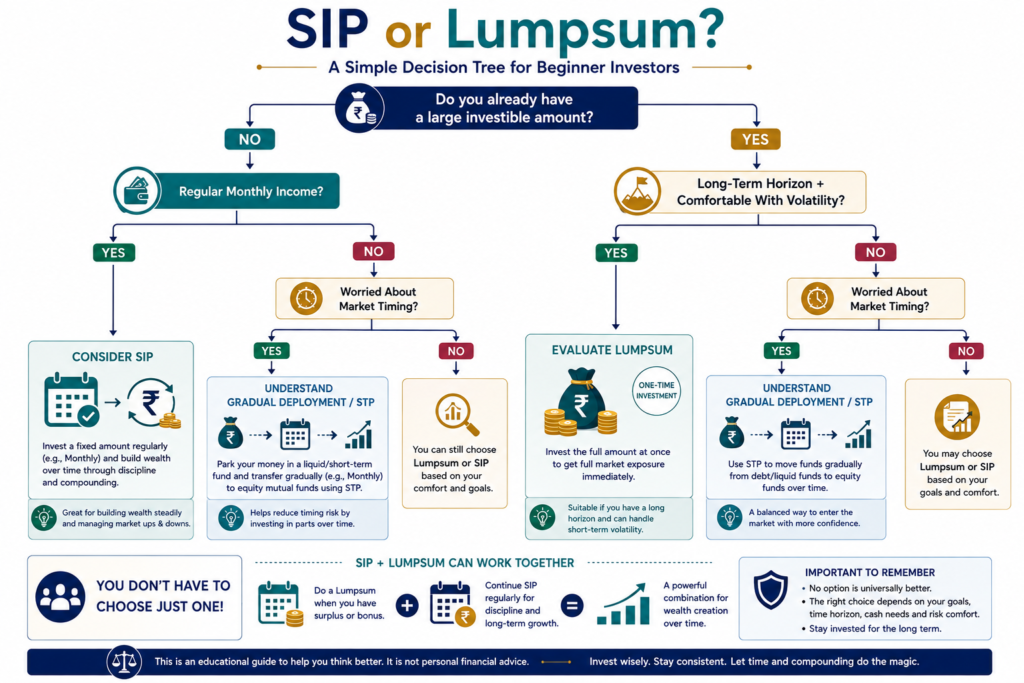
Situation 1: Salaried + No Large Corpus
Consider: SIP
Reason: income monthly aati hai, investment bhi monthly align ho sakti hai.
Situation 2: Large Amount Already Available
Consider: Lumpsum or staged deployment after assessing goals and risk.
Sirf SIP popular hai isliye large available capital ko indefinitely cash me rakhna automatically optimal nahi hai.
Situation 3: Market Timing Se Dar Lagta Hai
Consider: Gradual investing.
Ye emotional decision-making reduce karne me help kar sakta hai.
Situation 4: Long-Term Investor + High Volatility Tolerance
Available investible capital ke liye lumpsum consider kiya ja sakta hai, subject to asset allocation and suitability.
Situation 5: Monthly SIP Already Hai + Bonus Mila
Aapko SIP OR lumpsum choose karna compulsory nahi.
SIP + Lumpsum dono use kiye ja sakte hain.
SIP vs Lumpsum: Which is Better for a Salaried Person?
Most salaried beginners ke liye SIP practical hai because:
salary monthly → savings monthly → investment monthly.
For example:
Salary: ₹60,000
Investment capacity: ₹6,000/month
₹6 lakh accumulate hone ka wait karne ki jagah eligible investor ₹6,000 monthly invest karna start kar sakta hai.
But annual bonus ₹1 lakh mila?
Existing SIP stop karna necessary nahi.
Investor separate lumpsum investment evaluate kar sakta hai.
SIP or Lumpsum for Long Term?
Long-term investing me investment method se zyada important underlying investment, asset allocation, costs, risk and behaviour ho sakte hain.
A bad investment SIP ke through purchase karne se automatically good investment nahi ban jata.
Similarly, suitable diversified investment me lumpsum karna automatically bad decision nahi hai.
Before investing, check:
- Financial goal
- Investment horizon
- Risk tolerance
- Emergency fund
- Asset allocation
- Mutual fund category
- Expense ratio
- Exit load
- Tax implications
- Scheme Riskometer
Riskometer Check Karna Kyun Important Hai?
SIP ko “safe” samajhne ki common mistake mat karo.
SIP payment/investment method hai.
Risk underlying mutual fund scheme se aata hai.
Equity-oriented scheme aur low-risk debt-oriented product ka risk profile dramatically different ho sakta hai.
Isliye investment se pehle scheme ka SEBI-mandated Riskometer check karna useful hai.
Can You Invest Through SIP and Lumpsum Together?
Yes.
Example:
Monthly salary → ₹5,000 SIP
Annual bonus → ₹50,000 additional lumpsum
Extra surplus → goal aur asset allocation ke according additional investment
Ye approach investor ko regular discipline aur surplus capital deployment dono allow kar sakti hai.
Common SIP vs Lumpsum Mistakes Beginners Should Avoid
1. Past Returns Dekhkar Invest Karna
Last year ka top-performing fund next year bhi top perform karega, ye guaranteed nahi hai.
2. SIP Ko Guaranteed Return Samajhna
SIP market risk remove nahi karti.
3. Emergency Money Invest Karna
Near-term emergency money ko volatile investment me daalne se market decline ke waqt forced withdrawal ho sakta hai.
4. Perfect Market Bottom Ka Wait Karna
“Market aur 5% girega tab invest karunga.”
Perfect timing practically extremely difficult hai.
5. Market Crash Me Panic SIP Stop Karna
Temporary volatility aur changed financial goal same cheez nahi hain.
6. Riskometer Ignore Karna
Fund ka actual risk samjhe bina sirf SIP amount decide karna incomplete investment planning hai.
7. SIP vs Lumpsum Ko Competition Samajhna
Ye two rival products nahi hain.
Ye capital deploy karne ke different methods hain.
SIP vs Lumpsum FAQs
Is SIP Better Than Lumpsum?
Har situation me nahi. SIP regular income aur gradual investing ke liye convenient ho sakti hai, while lumpsum already-available capital ke liye suitable ho sakta hai depending on risk tolerance and investment horizon.
SIP vs Lumpsum Which is Better for Beginners?
Beginners jinke paas regular income hai but large investible corpus nahi, unke liye SIP simple starting approach ho sakti hai. Large corpus available hone par decision different ho sakta hai.
Which Gives More Returns: SIP or Lumpsum?
Koi fixed winner nahi. Returns market movement, investment timing, investment duration, underlying fund performance and amount invested par depend karte hain.
Is SIP Safe?
SIP itself mutual fund risk eliminate nahi karti. Risk underlying scheme par depend karta hai.
Can I Do SIP and Lumpsum in the Same Mutual Fund?
Many mutual fund schemes allow investors to make regular SIP investments as well as additional one-time investments, subject to scheme rules and minimum amounts.
Should I Invest Lumpsum When Market Falls?
Market fall alone investment decision ka sufficient reason nahi hona chahiye. Financial goals, asset allocation, risk tolerance and investment horizon consider karo. Nobody can reliably know in advance whether a current decline is the final bottom.
SIP or Lumpsum for 10 Years?
Both can be used for a 10-year horizon. Agar money gradually available hogi, SIP natural approach ho sakti hai. Agar corpus today available hai, lumpsum or staged deployment evaluate kiya ja sakta hai.
Can SIP Give Negative Returns?
Yes. Mutual funds market-linked hote hain, so SIP investments bhi negative returns experience kar sakti hain, particularly over shorter or adverse market periods.
SIP vs Lumpsum: Final Verdict
So, SIP vs Lumpsum — which is better in 2026?
Answer investor ki situation par depend karta hai.
SIP consider karo if:
- Income regularly aati hai
- Small amounts se start karna hai
- Investment discipline build karna hai
- Market timing decisions reduce karne hain
- Long-term goals ke liye regularly invest karna hai
Lumpsum consider karo if:
- Investible corpus already available hai
- Long-term horizon hai
- Short-term volatility tolerate kar sakte ho
- Asset allocation clear hai
- Entire amount invest karne ka risk samajhte ho
Aur yaad rakho:
SIP vs Lumpsum ka goal “winner” find karna nahi hai. Goal hai apne cash flow, financial goals aur risk profile ke liye suitable investment method choose karna.
Investing ka best method wahi hai jise aap samajhte ho, afford kar sakte ho aur long term responsibly follow kar sakte ho.
Start Planning Your SIP
Agar aap monthly SIP start karne ka plan bana rahe ho, different investment amounts, expected return assumptions aur investment periods ka potential future value estimate karne ke liye FinanceTrendAI SIP Calculator 2026 use kar sakte ho.
Expected return sirf illustration hota hai—actual mutual fund returns market performance par depend karte hain.
Disclaimer
This article is for educational and informational purposes only and should not be considered investment, tax, legal or financial advice. Mutual fund investments are subject to market risks. Returns are not guaranteed, and past performance does not guarantee future results. Read all scheme-related documents carefully and consider consulting a SEBI-registered investment adviser or other qualified professional where appropriate before making investment decisions.