
Agar aap soch rahe ho ki how to start SIP in India, lekin NAV, KYC, Direct Plan, Growth Option, expense ratio aur market risk jaise terms confusing lag rahe hain, to ye complete beginner guide aapke liye hai.
Good news ye hai ki SIP start karna utna complicated nahi hai jitna pehli baar dekhne me lagta hai.
Aapko lakhon rupaye ki zarurat nahi hai. Aapko stock market expert banne ki zarurat nahi hai. Aur aapko ye predict karne ki bhi zarurat nahi hai ki market next month upar jayega ya neeche.
SIP yani Systematic Investment Plan ek aisa investment method hai jisme aap fixed amount ko regular interval par mutual fund scheme me invest karte ho.
AMFI ke according, regular SIP ₹500 per month se start ki ja sakti hai, aur Chhoti SIP framework me ₹250 per month se bhi investment possible hai. June 2026 me India me SIP contributions ₹31,781 crore tak pahunch gaye the, jo clearly dikhata hai ki systematic investing Indian investors ke beech kitni popular ho chuki hai.
Lekin SIP start karne se pehle ek important confusion clear karna bahut zaroori hai:
SIP khud koi investment product nahi hai. SIP ek method hai jiske through aap mutual fund me regular investment karte ho.
Is guide me hum samjhenge how to start SIP in India, ₹500 se SIP kaise start kare, first mutual fund kaise choose kare, Direct vs Regular ka difference, Growth vs IDCW kya hota hai, SIP me risk kitna hai, market crash ke time kya karna chahiye, aur beginners ki common mistakes kya hoti hain.
By the end of this guide, aapko sirf how to invest in SIP nahi, balki SIP ko smartly start karne ka overall framework samajh aa jayega.

Table of Contents
SIP Kya Hai?
SIP ka full form hai Systematic Investment Plan.
Simple language me samjho to SIP ek aisa method hai jisme aap ek fixed amount ko regularly mutual fund scheme me invest karte ho.
For example, aap har month:
- ₹500
- ₹1,000
- ₹2,000
- ₹5,000
- ya ₹10,000
invest kar sakte ho.
Once aapki SIP active ho jati hai, selected amount aapke bank account se automatically debit ho sakta hai according to the schedule jo aapne choose kiya hai.
AMFI SIP ko ek periodic investment method ke roop me explain karta hai jisme investor ek fixed amount ko regular intervals par mutual fund scheme me invest karta hai.
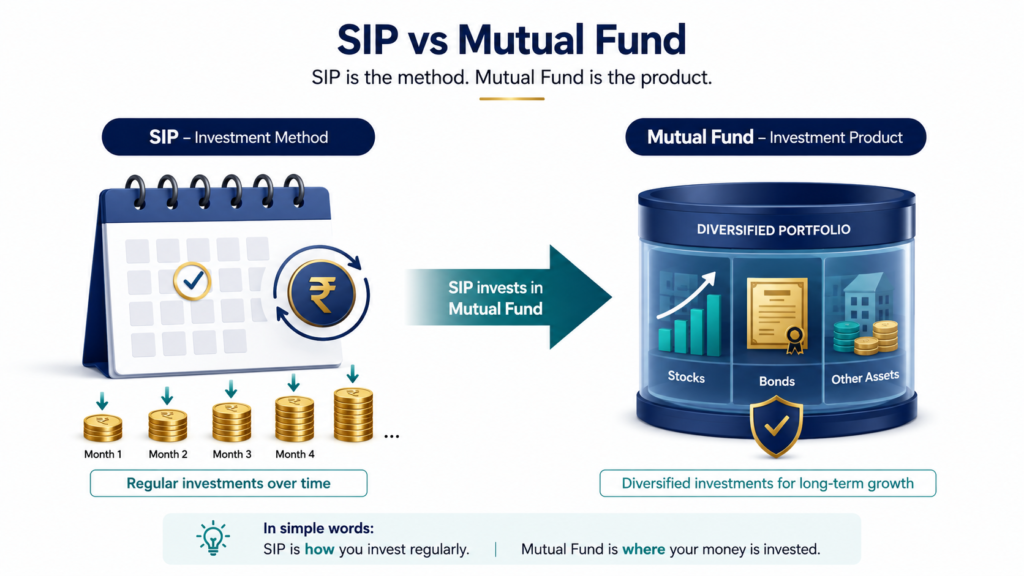
SIP aur Mutual Fund Same Nahi Hote
Ye beginners ki sabse common confusion hai.
Isko ek simple example se samjho:
Mutual Fund = Jahan aapka paisa invest hota hai
SIP = Jis method se aap regular paisa invest karte ho
Maan lo aap ₹2,000 per month ek index fund me invest karte ho.
Yahan:
Index Fund = Investment Product
₹2,000 monthly SIP = Investment Method
Ye difference samajhna bahut important hai.
SIP Kaise Kaam Karti Hai?
Maan lo aap ₹1,000 ki monthly SIP start karte ho.
Har month jab aapki SIP process hoti hai, aapke ₹1,000 se mutual fund units purchase hoti hain.
Units ki quantity applicable NAV par depend karti hai.
NAV ka full form hai Net Asset Value.
Simple language me, NAV mutual fund ke ek unit ki value hoti hai.
Ek simplified example dekho:
| Month | SIP Amount | Illustrative NAV | Units Purchased |
|---|---|---|---|
| January | ₹1,000 | ₹50 | 20.00 |
| February | ₹1,000 | ₹40 | 25.00 |
| March | ₹1,000 | ₹45 | 22.22 |
| April | ₹1,000 | ₹55 | 18.18 |
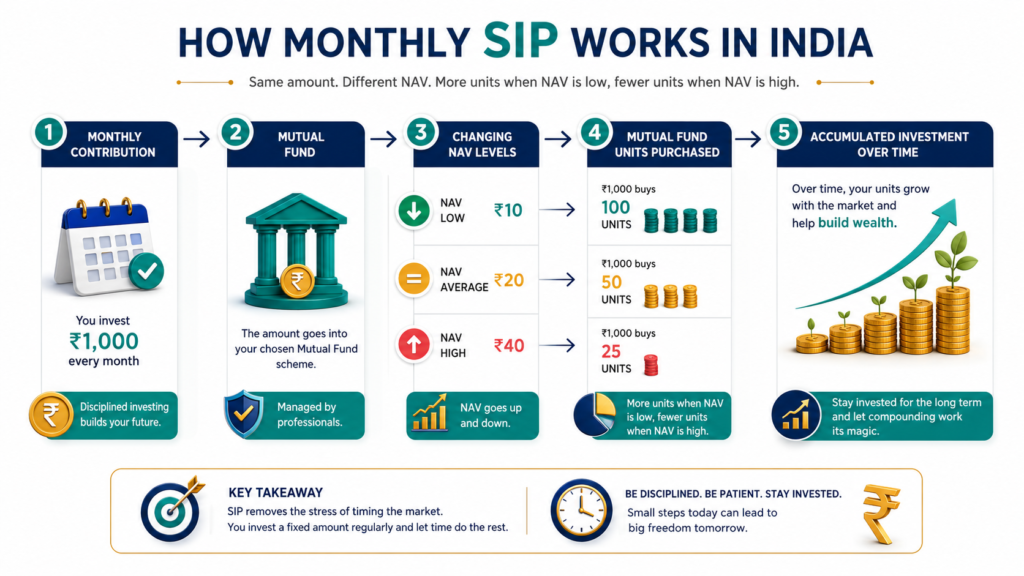
Jab NAV kam hota hai, same ₹1,000 me zyada units mil sakti hain.
Jab NAV high hota hai, same amount me comparatively kam units milti hain.
Isi concept ko broadly rupee-cost averaging ke saath relate kiya jata hai.
AMFI discipline aur rupee-cost averaging ko SIP ke major benefits me include karta hai.
Lekin ek baat clear rakho:
Rupee-cost averaging profit guarantee nahi karti.
Aapka actual return underlying mutual fund ki performance par depend karega.
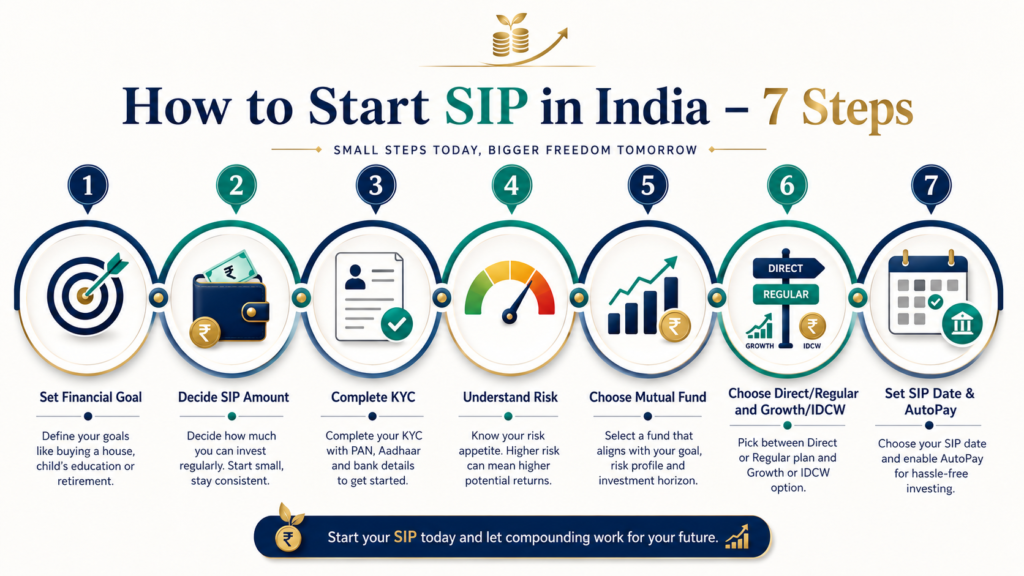
How to Start SIP in India: 7 Easy Steps
Ab aate hain main question par:
How to Start SIP in India?
Sabse common mistake ye hai ki beginner directly ye search karta hai:
“Best SIP kaunsa hai?”
Ye wrong starting point hai.
Aapka first question hona chahiye:
“Main invest kyu kar raha hoon?”
Neeche ek practical 7-step process diya gaya hai.
Step 1: Apna Financial Goal Decide Karo
SIP start karne se pehle clearly decide karo ki aapka goal kya hai.
For example:
- Retirement
- Child education
- House purchase
- Long-term wealth creation
- Future corpus
- Financial independence
- Travel fund
- Marriage fund
Goal important hai kyunki har mutual fund har objective ke liye suitable nahi hota.
Agar aapko paisa 2 saal me chahiye, to strategy alag hogi.
Agar aap 15–20 years invest kar sakte ho, to options alag ho sakte hain.
Sirf isliye koi fund choose mat karo kyunki usne last year high return diya.
Step 2: Decide Karo Kitna Invest Karna Hai
Dusre log ₹10,000 SIP kar rahe hain to iska matlab ye nahi ki aapko bhi ₹10,000 hi invest karna hai.
Aapka SIP amount aapke own budget aur monthly cash flow ke according hona chahiye.
Aap ₹500 se bhi start kar sakte ho, depending on scheme.
AMFI ke according regular SIP ₹500 se aur Chhoti SIP ₹250 se start ho sakti hai.
Agar aap comfortably ₹1,000 invest kar sakte ho, to ₹5,000 force mat karo.
Consistency zyada important hai.
Ek sustainable SIP jo 10 years chale, wo ek aggressive SIP se better ho sakti hai jo 4 months me band ho jaye.
Step 3: KYC Complete Karo
Mutual fund investment start karne ke liye KYC required hoti hai.
KYC ka full form hai:
Know Your Customer
Commonly aapse ye details/documents mangi ja sakti hain:
- PAN
- Aadhaar
- Bank account
- Mobile number
- Identity/address verification
Investment sirf legitimate AMC, authorised platform ya registered intermediary ke through hi karo.
Kabhi bhi OTP, password, UPI PIN ya banking credentials kisi unknown person ke saath share mat karo.
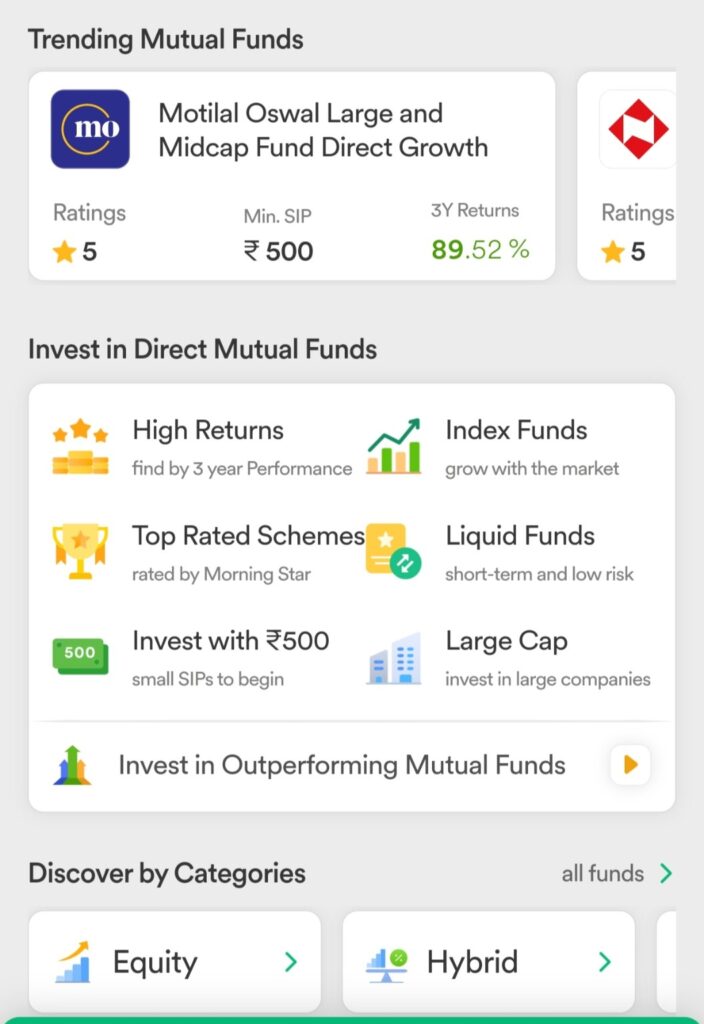
Disclosure: This is a referral link. I may receive a referral benefit if you open an account through this link.
Step 4: Apna Risk Samjho
Agar aap SIP investment for beginners search kar rahe ho, to ye section bahut important hai.
Mutual fund select karte waqt sirf return mat dekho.
Ye questions pucho:
Fund kis asset me invest karta hai?
Volatility kitni ho sakti hai?
Aap kitne time tak invest reh sakte ho?
Agar portfolio temporarily 20% down ho jaye to aap emotionally handle kar paoge?
SEBI mutual fund schemes ke liye Riskometer use karta hai jisse investor scheme ka risk level samajh sake.
Fund choose karne se pehle Riskometer aur scheme objective zaroor check karo.
SIP available hona automatically low-risk hona nahi hota.
Step 5: Direct vs Regular Plan Choose Karo
Mutual fund invest karte time aapko often do options milte hain:
Direct Plan
Isme aap directly fund house ya platform ke through invest karte ho without distributor commission.
Regular Plan
Isme distributor ya intermediary involved hota hai.
AMFI ke according Direct aur Regular plans ka underlying portfolio aur fund manager same ho sakta hai, lekin unka expense ratio different hota hai. Direct plans me generally expense ratio lower hota hai kyunki distributor commission nahi hota.
SEBI bhi ye explain karta hai ki Regular plans me intermediary cost involved ho sakti hai, jabki Direct plans generally lower-cost hote hain.
Beginner ke liye kya better hai?
Ye depend karta hai.
Agar aap research aur portfolio management khud comfortably kar sakte ho, Direct Plan useful ho sakta hai.
Agar aapko genuine professional guidance chahiye, Regular Plan relevant ho sakta hai.
Bas blindly kisi option ko choose mat karo.
Step 6: Growth vs IDCW Samjho
Mutual funds me aapko often two options milte hain:
Growth
and
IDCW
IDCW ka full form hai:
Income Distribution cum Capital Withdrawal
Simple way me samjho:
Growth Option
Returns fund me hi invested rehte hain.
IDCW Option
Fund time to time distribution kar sakta hai, subject to rules and availability.
Beginners ko sirf isliye IDCW choose nahi karna chahiye kyunki “regular income” sunne me attractive lagta hai.
Long-term wealth creation objective ke liye many investors Growth option consider karte hain.
Lekin personal suitability alag ho sakti hai.
Step 7: SIP Amount, Date Aur AutoPay Set Karo
Ab final setup simple hai.
- Mutual fund select karo
- SIP amount enter karo
- Frequency choose karo
- SIP date select karo
- Bank mandate / AutoPay set karo
- Details review karo
- Confirm investment
Ab technically aap samajh gaye ki how to start SIP in India.
Lekin real investing success sirf SIP activate karne se nahi aati.
Right fund selection + consistency + patience zyada important hain.
₹500 Se SIP Kaise Start Kare?
Agar aapka question hai:
Can I start SIP with ₹500?
To answer hai:
Yes, depending on the scheme.
AMFI ke according standard SIP ₹500 se start ho sakti hai, jabki Chhoti SIP ₹250 se possible hai.
Aapka basic process ye ho sakta hai:
₹500 monthly budget → Goal decide karo → KYC complete karo → Risk samjho → Mutual fund category choose karo → Plan choose karo → SIP activate karo
₹500 amount chhota lag sakta hai.
Lekin main point amount nahi hai.
Main point habit build karna hai.
Future me jab income increase ho, SIP amount bhi gradually increase kiya ja sakta hai.
₹500 SIP Future Me Kitni Grow Ho Sakti Hai?
Ek hypothetical illustration dekhte hain.
Maan lo aap ₹500 monthly invest karte ho aur average annualised return hypothetical 12% assume karte ho.
Approx result kuch is tarah ho sakta hai:
| Period | Total Invested | Approximate Value* |
|---|---|---|
| 5 Years | ₹30,000 | ~₹41,000 |
| 10 Years | ₹60,000 | ~₹1.16 lakh |
| 15 Years | ₹90,000 | ~₹2.52 lakh |
| 20 Years | ₹1.20 lakh | ~₹4.95 lakh |
| 25 Years | ₹1.50 lakh | ~₹9.39 lakh |
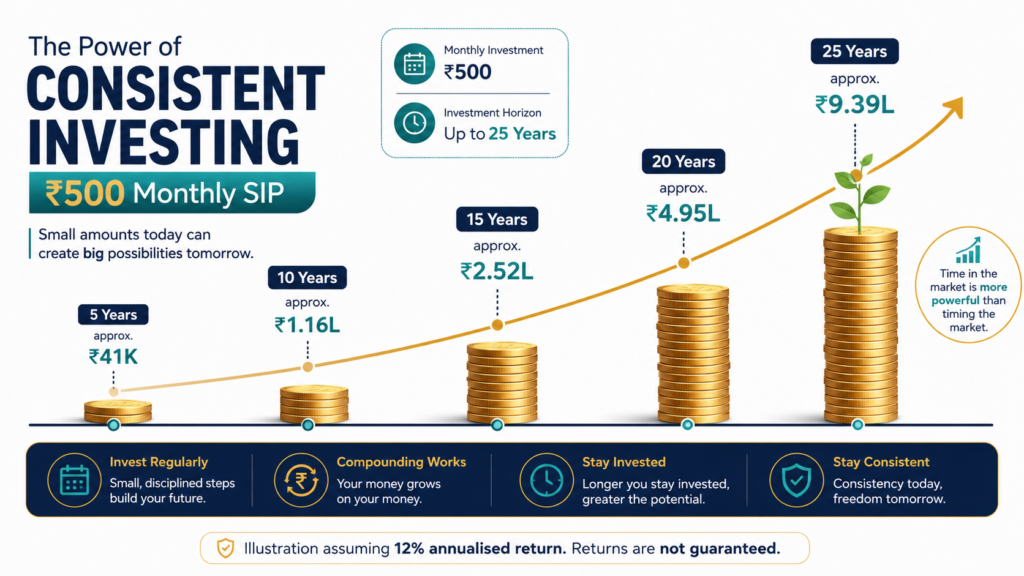
*Ye sirf illustration hai. 12% return assumed hai, guaranteed nahi. Actual returns market performance par depend karenge.
Online SIP calculator ko future guarantee mat samjho.
Calculator sirf mathematical projection dikhata hai.
Market return promise nahi karta.
₹500 vs ₹1,000 vs ₹5,000 SIP
Same hypothetical 12% annualised return assume karke ek comparison:
| Monthly SIP | 10 Years | 20 Years | 30 Years |
|---|---|---|---|
| ₹500 | ~₹1.16L | ~₹4.95L | ~₹17.65L |
| ₹1,000 | ~₹2.32L | ~₹9.89L | ~₹35.30L |
| ₹2,500 | ~₹5.81L | ~₹24.73L | ~₹88.25L |
| ₹5,000 | ~₹11.62L | ~₹49.46L | ~₹1.76Cr |
| ₹10,000 | ~₹23.23L | ~₹98.93L | ~₹3.53Cr |
Again:
Ye projected examples hain, guaranteed returns nahi.
Is table ka purpose ye dikhana hai ki:
Time + Amount + Return + Consistency
long-term outcome ko kaafi impact karte hain.
Apna First Mutual Fund Kaise Choose Kare?
How to invest in SIP samajhna relatively easy hai.
Lekin kis fund me SIP karni hai ye actual important decision hai.
Fund select karte time in points ko check karo:
1. Financial Goal
Aap invest kyu kar rahe ho?
2. Investment Horizon
Paisa kab chahiye?
3. Risk Tolerance
Aap market volatility kitni handle kar sakte ho?
4. Fund Category
Fund equity, debt, hybrid, index ya kisi aur category me hai?
5. Riskometer
Scheme ka risk level check karo.
6. Expense Ratio
Long-term me cost matter karti hai.
7. Investment Objective
Fund actually kis purpose se manage kiya ja raha hai?
8. Portfolio
Fund ka paisa kahan invest ho raha hai?
9. Past Returns
Past returns useful hain, lekin unhe future guarantee mat samjho.
SEBI investors ko risk aur expected returns ko consider karke decision lene ki importance explain karta hai.
Sirf “last 1 year return” sort karke first fund mat buy karo.
Direct vs Regular Mutual Fund: Beginner Ke Liye Kya Better Hai?
Simple comparison:
| Feature | Direct Plan | Regular Plan |
|---|---|---|
| Distributor | No | Yes |
| Expense Ratio | Generally Lower | Generally Higher |
| Guidance | Self-managed | Guidance mil sakti hai |
| Portfolio | Same underlying scheme | Same underlying scheme |
| Best For | DIY Investors | Guidance-seeking Investors |
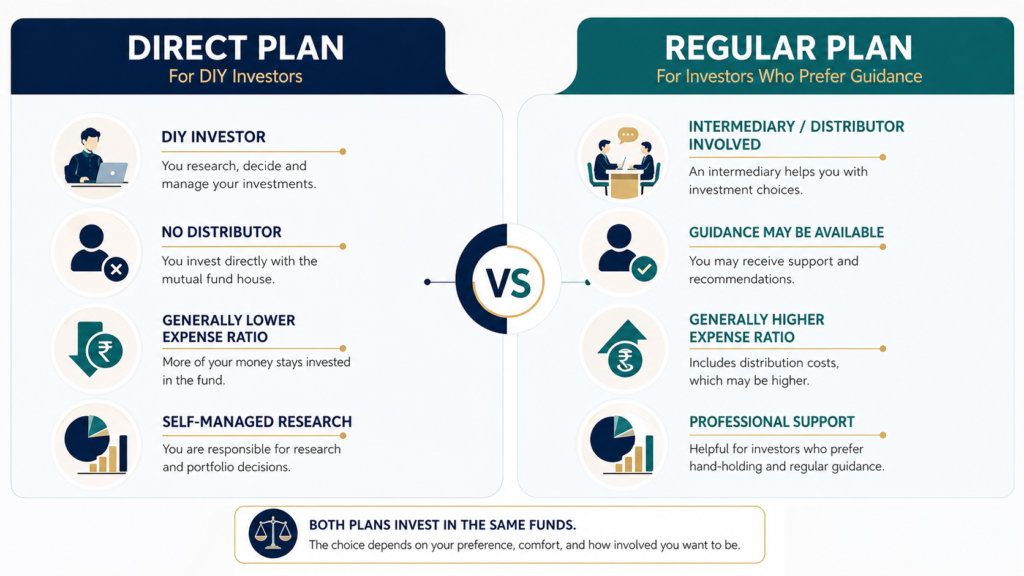
AMFI confirm karta hai ki same mutual fund scheme ke Direct aur Regular plans ka portfolio common ho sakta hai, lekin expense ratio different hota hai.
Agar aap how to start SIP in India research kar rahe ho, Direct vs Regular difference ignore mat karo.
Small cost difference long term me compounding ke through meaningful ho sakta hai.
Growth vs IDCW: Kya Choose Kare?
Agar aapka goal long-term wealth creation hai, to Growth option often relevant ho sakta hai because returns fund me invested rehte hain.
IDCW me distribution ho sakta hai.
Lekin IDCW ko “guaranteed income” mat samjho.
Final decision aapke goal, tax situation aur financial requirements par depend karta hai.
SIP vs Lump Sum
SIP
Aap regular intervals par smaller amount invest karte ho.
Lump Sum
Aap ek bada amount ek saath invest karte ho.
Koi bhi option universally best nahi hai.
Salaried investor ke liye SIP practical ho sakti hai because monthly salary ke saath investment align ho jata hai.
Agar kisi ke paas already large amount available hai, uska decision different ho sakta hai.
SIP ka biggest practical benefit often discipline + automation hota hai.
Guaranteed superior return nahi.
Step-Up SIP Kya Hoti Hai?
Maan lo aaj aap ₹2,000 per month SIP start karte ho.
Salary increase hone ke baad aap SIP ko ₹2,500 kar dete ho.
Next year ₹3,000.
Isi idea ko Step-Up SIP kaha jata hai.
Ye approach useful ho sakti hai because aapki investment contribution income ke saath grow karti hai.
Beginners sirf “best SIP” search karte reh jaate hain.
Kabhi-kabhi investment amount gradually increase karna bhi equally important hota hai.
Best SIP Date Kaunsi Hoti Hai?
1st?
5th?
10th?
15th?
25th?
Bahut beginners magical SIP date dhundte rehte hain.
Practical answer:
Aisi date choose karo jo aapke cash flow ke liye convenient ho.
Example:
Agar salary 1st ya 2nd ko aati hai, to SIP 5th ya 7th ke around rakhna operationally comfortable ho sakta hai.
Long-term result ek particular date se zyada depend karega:
- Fund performance
- Investment amount
- Investment duration
- Risk
- Consistency
SIP date ko market timing strategy mat banao.
Market High Ho To SIP Start Kare Ya Wait Kare?
Ye SIP for beginners in India ka ek very common question hai.
Aap dekhte ho market already high hai.
Aap sochte ho:
“Crash ke baad invest karunga.”
Market crash nahi karta.
Aur 10% upar chala jata hai.
Phir aap dobara wait karte ho.
Systematic investing ka ek benefit ye hai ki aap har baar market timing guess karne ki habit reduce karte ho.
SEBI investor education material me volatile markets ke during SIP continue karne se related awareness content provide karta hai.
Lekin SIP loss-proof nahi hai.
Agar underlying market/fund girta hai, portfolio value gir sakti hai.
SIP Me Loss Ho Sakta Hai?
Yes.
Ye point clear rehna chahiye.
SIP:
- Guaranteed return nahi deti
- Capital guarantee nahi karti
- Market risk eliminate nahi karti
Risk underlying mutual fund par depend karta hai.
Isi reason se Riskometer important hai.
Better way to understand:
SIP investment ka systematic method hai. Risk mutual fund scheme ka hota hai.
Kya SIP Kabhi Bhi Stop Kar Sakte Hain?
Generally, future SIP instalments ko applicable process ke through stop kiya ja sakta hai.
Lekin ye samjho:
SIP stop karna aur investment redeem karna same nahi hai.
SIP stop karne ka matlab future instalments band karna.
Redeem karne ka matlab existing mutual fund units sell karna.
Exit load, tax aur scheme-specific conditions redeem karte time applicable ho sakti hain.
SIP Miss Ho Jaye To Kya Hota Hai?
Maan lo bank account me balance nahi tha aur SIP debit fail ho gaya.
Ek failed SIP ka matlab ye nahi ki aapke existing mutual fund units disappear ho jayenge.
Aapki already purchased units remain invested.
However, repeated failed instalments par SIP discontinue treat ki ja sakti hai.
AMFI ke according certain frequencies ke liye three consecutive failed instalments, aur some other intervals ke liye two consecutive failed instalments SIP cessation/discontinuation trigger kar sakte hain.
Bank charges ya platform-related terms bhi apply ho sakte hain.
Agar Investment App Band Ho Jaye To Paisa Safe Hai?
Ye beginner ka genuine fear hai.
Aap sochte ho:
“Agar Groww/Zerodha ya koi investment app future me band ho gaya to mera mutual fund kya hoga?”
Investment platform aur underlying mutual fund ownership structure ko same mat samjho.
Mutual funds India me regulated ecosystem me operate karte hain.
SEBI investor resources mutual fund regulation, NAV disclosure, portfolio disclosure aur investor protection framework explain karte hain.
Fir bhi:
Investment records maintain karo.
Statements regularly check karo.
Sirf ek app display par completely dependent mat raho.
SIP Taxation India Me Kaise Work Karti Hai?
SIP ke naam se separate tax structure nahi hota.
Tax generally depend karta hai:
- Mutual fund type
- Unit purchase date
- Holding period
- Redemption date
- Current tax law
Important:
Har SIP instalment separate date par mutual fund units purchase karti hai.
Isliye taxation aur holding period calculate karte time each instalment relevant ho sakti hai.
Tax laws change ho sakti hain, to redemption ke time latest tax rules verify karo.
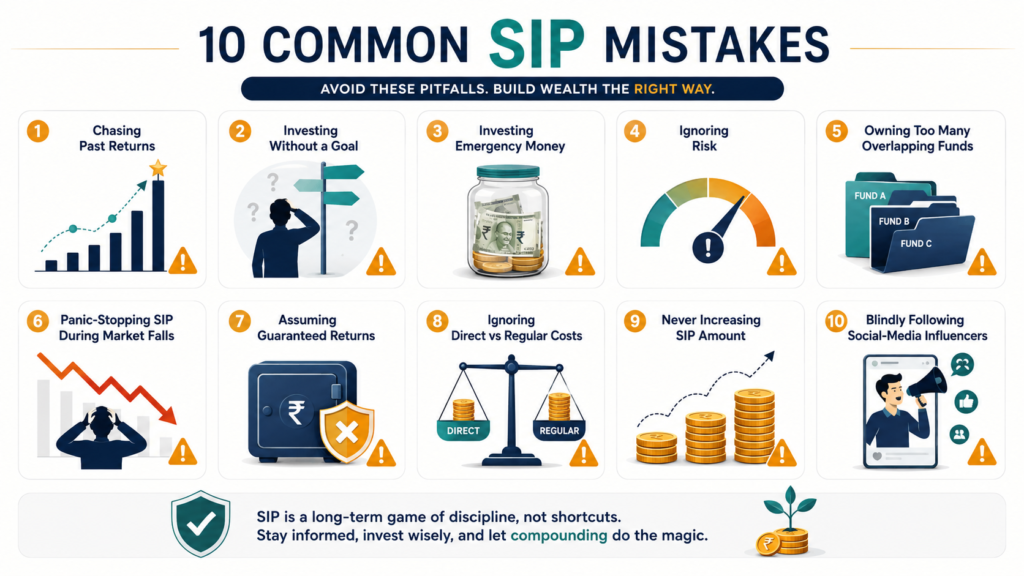
Beginners Ki 10 Common SIP Mistakes
1. Past Returns Dekhkar Fund Select Karna
Last year ka top performer future ka top performer hona guaranteed nahi hai.
2. Without Goal SIP Start Karna
“Sab log SIP kar rahe hain” proper financial goal nahi hai.
3. Emergency Money Invest Kar Dena
Emergency fund aur long-term investment same purpose serve nahi karte.
4. Riskometer Ignore Karna
Higher potential return often higher risk ke saath aata hai.
5. Too Many SIPs Start Karna
Zyada funds = automatically better diversification nahi.
6. Market Girte Hi SIP Stop Karna
Panic-based decision long-term plan ko damage kar sakta hai.
7. 12–15% Return Guaranteed Samajhna
Online SIP calculator assumed return use karta hai.
Market guarantee nahi deta.
8. Direct vs Regular Ignore Karna
Cost structure samajhna zaroori hai.
9. SIP Amount Kabhi Increase Na Karna
Income grow ho rahi hai to investment contribution bhi review karo.
10. Social Media Influencers Ko Blindly Follow Karna
Unka goal, income, risk aur time horizon aapse different hai.
How to Start SIP in India: Beginner Checklist
SIP start karne se pehle ye questions check karo:
☐ Mera financial goal kya hai?
☐ Mujhe paisa kab chahiye?
☐ Kya mere paas emergency fund hai?
☐ Main monthly kitna comfortably invest kar sakta hoon?
☐ Kya mujhe fund category samajh aati hai?
☐ Kya maine Riskometer check kiya?
☐ Kya mujhe Direct vs Regular difference samajh hai?
☐ Kya mujhe Growth vs IDCW samajh hai?
☐ Kya maine scheme objective padha hai?
☐ Kya main sirf recent returns dekhkar invest nahi kar raha?
Agar in questions ke answers clear nahi hain, to jaldi invest karne ki zarurat nahi.
Pehle samjho.
Phir invest karo.
Frequently Asked Questions
SIP start karne ke liye minimum amount kitna chahiye?
AMFI ke according regular SIP ₹500 se start ho sakti hai aur Chhoti SIP ₹250 se possible hai. Exact minimum scheme ke according vary kar sakta hai.
Kya ₹500 se SIP start kar sakte hain?
Yes. ₹500 SIP beginners ke liye practical starting point ho sakti hai, subject to scheme minimum.
How to Start SIP in India for Beginners?
Goal decide karo, KYC complete karo, risk profile samjho, suitable fund category research karo, Direct vs Regular choose karo, amount/date set karo aur SIP activate karo.
SIP safe hai?
SIP itself ek investment method hai. Risk underlying mutual fund par depend karta hai.
SIP me negative return aa sakta hai?
Yes.
Mutual funds market-linked hain, isliye portfolio value down bhi ja sakti hai.
₹1,000 SIP start karne ke liye enough hai?
Yes, ₹1,000 beginner ke liye reasonable starting amount ho sakta hai where scheme permits.
Beginners ke liye best SIP kaunsi hai?
Koi single SIP sabke liye best nahi hoti. Choice goal, risk tolerance aur investment horizon par depend karti hai.
SIP ke liye Demat account required hai?
Mutual fund investment ke liye Demat account universally compulsory nahi hai. Different permitted holding modes available hote hain.
Kya SIP ka paisa kabhi bhi withdraw kar sakte hain?
Many open-ended mutual funds redemption allow karte hain.
Lekin exit load, tax aur scheme terms check karo.
Kya SIP stop kar sakte hain?
Generally yes.
Future SIP instalments stop ki ja sakti hain according to applicable process.
Market crash me SIP stop karni chahiye?
Sirf market fall ke basis par panic decision avoid karo.
Goal, time horizon aur fund suitability review karo.
SIP ke liye best date kaunsi hai?
Koi universally best date nahi hai.
Aisi date choose karo jo aapke cash flow ke liye comfortable ho.
SIP aur mutual fund me kya difference hai?
Mutual fund investment product hai.
SIP investment method hai.
Beginner ko kitni SIPs rakhni chahiye?
Koi fixed number nahi hai.
Zyada SIPs automatically better portfolio nahi banati.
SIP FD se better hai?
Dono different products hain.
Risk, return, liquidity aur taxation characteristics different ho sakti hain.
Final Thoughts: Kya Aapko 2026 Me SIP Start Karni Chahiye?
How to start SIP in India samajhna sirf Invest button click karna nahi hai.
Real questions ye hain:
Aap invest kyu kar rahe ho?
Kitne saal invest reh sakte ho?
Kitna risk handle kar sakte ho?
Aap exactly kis fund me invest kar rahe ho?
Kya aap consistently invest kar paoge?
₹500 SIP aapko overnight rich nahi banayegi.
Aur long-term investing ka purpose bhi overnight rich banna nahi hota.
Small amount se start karo.
Investment samjho.
Recent return chase mat karo.
Income badhne par contribution review karo.
Aur periodically check karo ki fund aapke goal ke according suitable hai ya nahi.
Agar aap beginner ho, to how to start SIP in India samajhne ke baad next logical step hai:
Mutual fund kaise choose kare?
Blindly app ke top-listed fund me invest karna next step nahi hona chahiye.
Disclaimer: Ye article sirf educational aur informational purpose ke liye hai. Ye investment, tax ya personalised financial advice nahi hai. Mutual fund investments market risk ke subject hain. Scheme-related documents carefully read karein aur zarurat pade to SEBI-registered investment adviser ya qualified financial professional se advice lein.